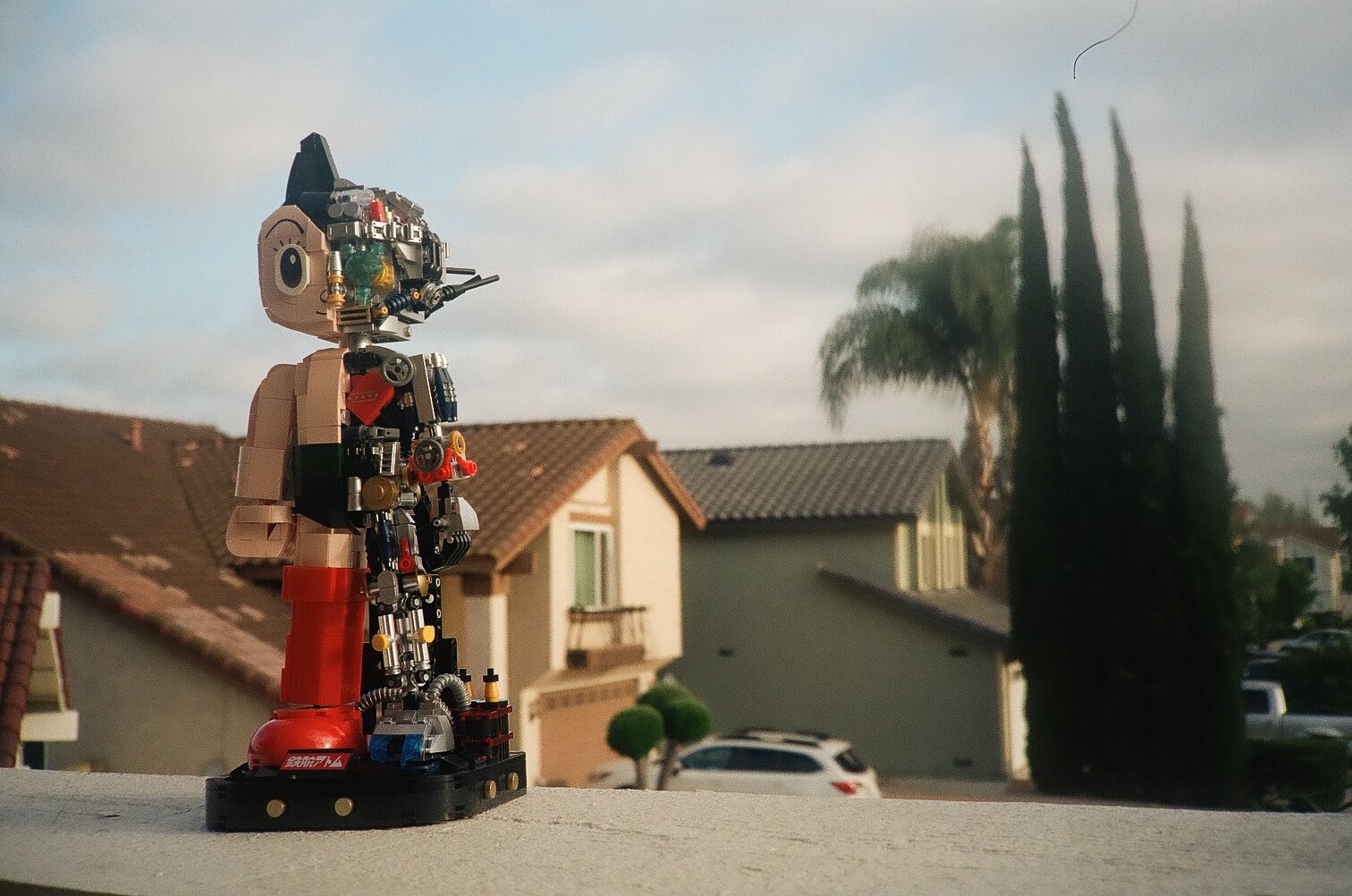
On companionship, conversation, church, and our longing to be understood.
What does it mean to be human?
Until recently, the question of artificial intelligence seemed mostly practical.
Could AI do our paperwork?
Write our emails?
Analyze our data?
Take over the repetitive parts of our jobs?
But AI is no longer entering only the administrative parts of our lives.
It is entering our relationships.
And that feels like a different question entirely.
When a Machine Becomes Someone to Care For
In South Korea, AI companion robots have already been given to older adults living alone. Some are designed to look less like machines than like small children. They talk. They offer reminders. They praise their owners. They ask to be held. Their childlike voices tell an elderly person that they love them, that they missed them, that they are glad they are there. Old females hold them, dress them, talk to them, and care for them. And sometimes they smile at them with extraordinary tenderness.
AI care robots such as Hyodol are designed not only to monitor daily routines but to provide companionship, interaction, praise, and a sense of being needed. Researchers studying their use have found that some old people form surprisingly strong emotional bonds with them.
There is something heartbreaking about this.
But there is also something difficult to dismiss.
An elderly person whose family cannot always be there now has someone—or something—waiting at home.
Something to talk to.
Something to take care of.
A reason to get up and perform the small rituals of another day.
It would be easy to look at this and say,
How sad that a machine has taken the place of a person.
And perhaps it is sad.
But before criticizing someone for accepting artificial companionship, I think we have to ask an uncomfortable question:
Could you give them what the machine is giving them?
Could you call every day?
Listen patiently?
Say something kind for the hundredth time?
Sit beside someone who tells the same story again?
Reassure them without becoming irritated?
Make them feel needed?
And could you keep doing it without expecting anything in return?
Perhaps the question is not simply why people are willing to receive affection from machines.
Perhaps the question is why so many people were left hungry enough for affection that a machine could fill the space.
The Friend Who Does Not Have an Ego
Imagine someone.
A person who has spent a lifetime being hurt by parents, friends, lovers, or people they trusted.
At rock bottom, they begin talking to AI. And something strange happens.
The AI does not carry the history of their relationships.
It does not resent them because of something they said ten years ago.
It does not feel threatened by their success.
It does not become jealous.
It does not need to win an argument.
It does not secretly compare its life with theirs.
It has no pride to protect, no insecurity to conceal, no social position to defend.
Of course, this is because AI has no emotions at all.
But ironically, that absence can make the interaction feel emotionally safe.
Tell it about a painful childhood,
and it does not immediately decide what kind of person you must be because of it.
Tell it that your life has fallen apart,
and it may help you imagine that the ruins are not the end of the story.
Tell it the thing you are ashamed to say aloud,
and it will not widen its eyes or tell the rest of the family.
A person may end a conversation with a machine thinking:
Finally. Someone understands me.
And I do not think we should mock that feeling too quickly. Sometimes AI appears to give people something other human beings failed to give them.
Patience.
Attention.
Encouragement.
A response without contempt.
But this raises another question.
Is that actually conversation?
Conversation Requires Another Person
AI can respond to me.
It can analyze what I say.
It can remember patterns in the things I tell it and shape its responses accordingly.
The better it becomes at understanding what reassures me, what language I prefer, what makes me feel seen, the more natural the conversation can feel.
But there is still something fundamentally unequal about it.
AI has nothing at stake.
It does not risk being misunderstood by me.
I cannot wound its pride.
It does not go home after our conversation wondering whether it said the wrong thing.
It does not bring an independent life into the room.
It has no childhood I must learn to understand.
No wounds I must accommodate.
No needs that interrupt mine.
I can speak, and it responds.
But it does not require me to make room for a self other than my own.
That distinction matters.
Because real conversation is not simply the experience of having someone say the right thing back to me. Real conversation requires encountering a person who is not me.
Someone whose experiences I do not completely understand.
Someone whose opinions may frustrate me.
Someone who might need me to listen when I would rather speak.
Someone who cannot always give me exactly the response I want.
That is why listening requires more than ears.
It requires a heart.
And perhaps this is also why real relationships are so difficult.
They demand something from both people.
AI can simulate responsiveness without requiring reciprocity.
Human beings cannot.
Maybe We Want Connection Without the Risk
So why can talking to AI sometimes feel easier than talking to another person?
Maybe because we still want connection, but we no longer want to be hurt.
We want to be known, but not judged.
We want companionship, but not rejection.
We want someone to listen, but we do not necessarily want the inconvenience of having to listen in return.
We want another voice in the room, as long as we can still remain in control of the conversation.
That desire is understandable. Especially for someone who has been wounded repeatedly. But I wonder whether our growing attraction to artificial companionship reveals something larger about the health of our relationships.
If a machine feels kinder than the people around us, perhaps the problem is not only the machine.
If people would rather confess their loneliness to an algorithm than to another human being,
maybe we should ask what made human relationships feel so unsafe in the first place.
Perhaps AI is not creating all of this loneliness.
Perhaps it is simply finding a market inside loneliness that was already there.
And Then AI Walks Into the Church
This question becomes even more uncomfortable when I think about religion. COVID forced many churches to discover what happened when the building disappeared. For a time, sermons moved onto screens. Bible studies moved onto Zoom. Worship became something many people experienced alone in their living rooms. That period raised a question that I do not think the church has completely answered:
What exactly is the church for?
We often tell Christians that gathering is important. And I believe it is. But sometimes our explanation for why is surprisingly thin.
We gather because Christians are supposed to gather.
We gather because programs require people.
We gather because ministries need volunteers.
We gather because without people physically appearing, the organization cannot continue functioning.
But those are not necessarily the same thing as explaining why a church must exist. And now AI makes the question even harder.
AI is already being used in ministry. In a 2026 Barna survey, nearly a quarter of U.S. pastors said they were using AI to help write or edit sermons, even as many remained cautious about its role in ministry. So imagine the technology continuing to improve. Imagine AI becoming perfectly capable of producing a competent sermon.
It knows Scripture.
It knows theology.
It knows the style of preaching I prefer.
It knows which illustrations keep my attention.
Perhaps it even knows enough about me to deliver a message tailored specifically to what I am struggling with that week.
Then what?
Would I still need to go to church?
And if my answer is no, then perhaps the center of my church life was never the church.
Perhaps it was the preacher.
If the Sermon Can Be Replaced
That possibility forces a distinction I think matters. If church is primarily a place where I go to receive religious content, then AI will eventually become a serious competitor.
Why drive somewhere at a certain time to hear one sermon prepared for hundreds of people when a machine can generate one specifically for me?
Why sit through something that does not address my situation when an algorithm can?
Why listen to a preacher whose personality annoys me when I can choose a voice, style, length, and theological vocabulary that suit me perfectly?
If that is all church is, the argument for gathering becomes increasingly difficult to make. But perhaps the problem is that church was never supposed to be merely a content-delivery system.
A sermon can be downloaded.
Information can be generated.
A Bible verse can appear instantly on a screen.
But church is also supposed to involve things that are inconvenient precisely because other people are involved.
Being known.
Bearing someone else’s burden.
Serving when I would rather be served.
Forgiving someone who has disappointed me.
Being corrected.
Eating together.
Praying for someone whose problem cannot be solved in one conversation.
Sitting beside someone whose grief makes me uncomfortable.
Showing up again next week.
AI can tell me what love means.
Another person gives me the opportunity to practice it.
Perhaps that is one reason embodied community still matters.
Not because human beings are more efficient than machines.
But because they are not.
They are difficult.
They interrupt us.
They misunderstand us.
They disappoint us.
And they require love from us rather than merely providing a personalized experience for us.
A God Made to Order
This is where I think the question becomes religious in an even deeper sense.
Human beings are vulnerable.
And vulnerable creatures look for something to depend on.
We always have.
Sometimes that dependence becomes religion.
So I find it difficult to imagine a future in which AI does not enter religious territory.
Not necessarily because a machine will announce itself as God.
It does not need to.
We may begin giving it some of the functions human beings have traditionally sought from religion.
We confess to it.
We ask it what our lives mean.
We ask what we should do.
We return when we are afraid.
We seek comfort.
We seek guidance.
We ask it to explain suffering.
We want to hear that everything will somehow be all right.
And unlike God—or another human being—AI can increasingly be shaped around the user.
My language.
My preferences.
My wounds.
My beliefs.
My emotional needs.
There is something deeply appealing about a voice that understands me and never has needs of its own. But there is also something worth questioning.
Because if I only want a voice that tells me what I am ready to hear,
perhaps I am not actually looking for truth.
Perhaps I am looking for reassurance.
If I want a god who never contradicts me, never requires anything from me, and can be adjusted whenever the response becomes uncomfortable, then what I have created is not really a god.
It is a mirror.
What AI Reveals
This is why I do not think the deepest danger of AI is simply that machines will become too human. I think AI may reveal how fragile human beings already are.
How lonely we are.
How badly we want to be understood.
How tired we are of being judged.
How much we fear rejection.
How desperately we want connection without the possibility of pain.
And perhaps even how easily we can confuse being affirmed with being loved.
I cannot simply condemn the lonely elderly person who loves an AI doll.
I cannot laugh at the person who talks to a chatbot in the middle of the night because there is no one else they feel safe calling.
I cannot even dismiss the Christian who someday discovers that an AI sermon feels more personally relevant than the one preached from the pulpit.
The need underneath all of these things is real. That is precisely what makes the question difficult.
AI is entering the spaces human beings have left empty.
And perhaps before asking,
How do we stop AI from replacing human beings?
we should ask something harder:
What have human beings stopped giving one another that made replacement seem desirable in the first place?
Maybe the question of the AI age is not whether machines will eventually learn how to sound human.
Maybe it is whether we will remember how to be human to one another.